Wednesday, April 21, 2021

What Scots are Reading: Poetry

We ask fellow Scots to tell us about a book they've recently enjoyed. Hewes Library welcomes contributions from students, faculty, staff and alumni. If you would like to contribute a review, drop a note to: reference@monmouthcollege.edu. 


Miho Nonaka. The Museum of Small Bones. Ashland, 2020.
Kerrin McCadden. American Wake. Black Sparrow, 2021.
Reviewed by David Wright, Associate Professor of English

During the Fall 2020 semester, I was on sabbatical leave, writing and revising poems for a new poetry collection. But the central rejuvenating activity of my sabbatical was the chance to read: books on writing and reading, works of literary criticism, essay collections, memoirs, studies on teaching/pedagogy, and considerations of the current crisis in higher education. All of the writing I was able to accomplish above would’ve been impossible to imagine if I had not been able to immerse myself in these works, along with, nearly every day, a chance to read individual poems, essays, studies, and discussions via social media. See the attached photo for a visual of what it looks like when professors finally have the freedom to read work we are not necessarily preparing to teach in a classroom (and send me a note if you’d like the full bibliography!)
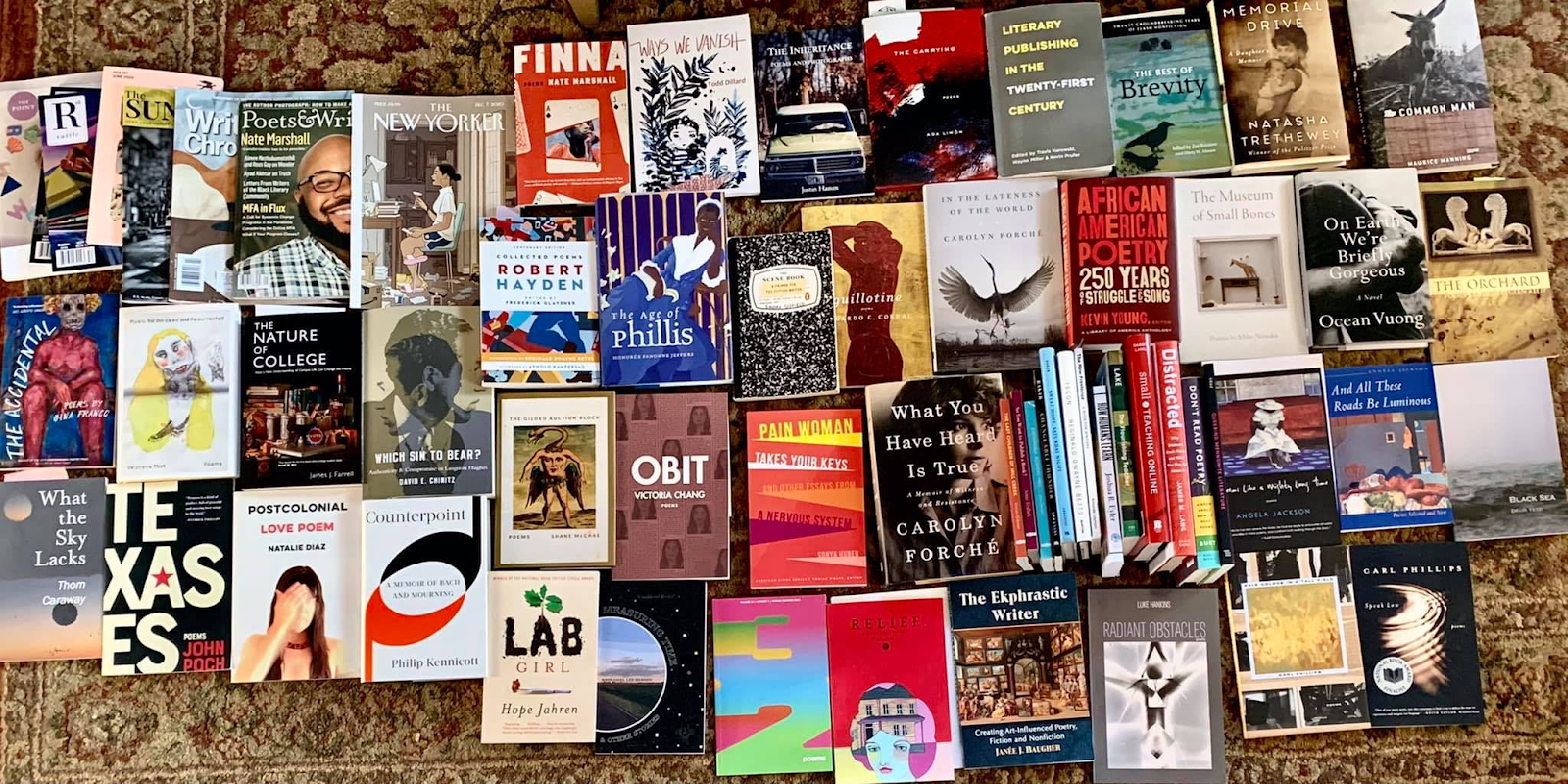


What you might notice most from this photo is how many individual collections of poetry I was able to slow down and enjoy. If you are not a regular reader of  poetry, I invite you to consider picking up a full collection by a single writer, taking the risk of a slow, patient encounter with one poet’s imagination, language, and experience, the way some of us used to listen to full albums, one side of the record and one song at a time. Simply have the experience you have of the work, not worrying about “hidden meanings” or “solving” the poem. 


Here are two recent collections, both by poets I know, that I would recommend:


Miho Nonaka’s The Museum of Small Bones is a study in paying attention to the world through and within language. A bilingual writer, her poems attend to both her Japanese heritage and language and her experience of life in the West. In the collection’s title poem, she describes both a trip to an actual Tokyo museum with a friend and gives away her hope for what poetry might do. She writes, 


God must know why our lives are

so illogical. I dreamed of a power


to make small, imperceptible things

perceptible, like the pattern of bones of a bat

in flight. The power to stave off despair. 


To make “imperceptible things /perceptible” is one of a poet’s powers in our human quest to push back against despair, and Nonaka is an expert in this art. In “The Production of Silk,” a series of some thirty prose poems, Nonaka considers her family's heritage as skilled artisans or shokunin. “Of all the ways I reassure myself,” she writes in one poem, “I am most comforted to remember that I come from a family of shokunin. I never believed that the self is a project of one’s own making, and having a specific role assigned to me is, paradoxically, a form of freedom.” We are saved from ourselves, or from despair, not by “magical encounters” or “charisma but by “small works I am equipped to do, tasks that require faithful use of my hands, shaping things for someone beyond my immediate reality.” 


Those small tasks ground the poet/shokunin both in her body and in her community, the people beyond us. Each of these poems is such an attentive act of care and creation, not merely for the writer but for readers, as the collection’s last poem ends: “It’s you, waiting to be translated.”


In American Wake, Kerrin McCadden also calls for us to pay attention--to place, to loss, to abundance--and then enacts just how hard it can be to see any one thing, person, experience, word as only itself. The poems shuttle back and forth between Ireland and Vermont, between the time before and after her brother’s death. As the book’s publisher reminds us, “an American wake is what the Irish call a farewell to those emigrating to the United States.” It is of course also what we call a mourning party for the dead when we share tales of the dead. And a wake is also what we can be caught up in when we are in the water and a ship passes by, or when life’s circumstances catch us up and set us down someplace unexpected.


What I admire most about McCadden’s poems is the sheer energy and abundance of them, as well as her endless playfulness with structures and forms. Some poems are sonnets while others are lists, or dictionary definitions, or even a choose your own adventure riff. In each case, she is pressing on all the possible meanings of any given word, as in “Passerines”, where she returns again and again to the phrase “I want to tell you” while she considers this name for a kind of bird. But of course that desire to pin down meaning is as impossible as holding a bird in one’s hand forever, or of knowing the future:


Passerine, I thought, Passerine

                a more future verb tense for to pass, a tense I can’t

                know yet—a passing I can’t understand.


At the heart of any wake is loss, a deep reckoning with a passing too hard to understand. And McCadden’s poems about her brother’s death show all the ranges of anger, grief, celebration, incomprehension, clarity, and consequence that come from a loved one’s death by drug overdose. In “When My Brother Dies,” McCadden realizes in the first few lines: “It happened already. It has happened five times / and will happen again.” Death from addiction, the poem shows us, happens many times before it happens:


“Which death are my parents crying about /now? I wonder if it’s motorcycle death, or locked / in jail death.” And so on goes the list. And so on go the poems, including one titled “reverse overdose.”


If you read McCadden’s collection, you will also come to know that “wake” also means coming into consciousness, to awaken, and that is another gift of her poems’ relentless refusal to accept easy comfort: “This morning I bramble toward waking,” she writers in a poem that also includes these lines:


Somewhere, 

someone finds me phenomenal--I stand 

so tall and keep the future as a pet. Together we swim 

the headwaters like children who don’t know 

the rules. 


Someone, somewhere does find us phenomenal, invites us all to awaken to the layered possibilities of attending our worlds through language, swimming together until we are fully aware of what we know and what we don’t, a waking that McCadden and Nonaka both offer us in their poems if we’ll take the risk of reading them.


The Museum of Small Bones by Miho Nonaka (2020) is available to borrow via interlibrary loan and for purchase via Ashland Poetry Press.


American Wake by Kerrin McCadden (2021) is available for purchase via Godine.com.

Friday, April 16, 2021

New Items at Hewes Library

New items are added to the Hewes Library collection on a continual basis. Recent titles have included: 

  • Animal, Vegetable, Junk: A History of Food, From Sustainable to Suicidal by Mark Bittman
  • Lost and Found: Young Fathers in the Age of Unwed Parenthood by Paul Florsheim and David Moore
  • Policing in 2020 by Grey House Publishing
  • Fruit Trees for Every Garden: An Organic Approach to Growing Apples, Pears, Peaches, Plums, Citrus and more by Orin Martin
  • Halfway Home: Race, Punishment and the Afterlife of Mass Incarceration by Reuben Jonathan Miller
  • LGBTQ Mental Health: International Perspectives and Experiences edited by  Nadine Nakamura and Carmen H. Logie
  • Consuming Stories: Kara Walker and the Imagining of American Race by Rebecca Peabody
  • Tragic Heroines in Ancient Greek Drama by Hanna M. Roisman
  • Other People's English: Code-Meshing, Code Switching, and African American Literacy by Vershawn Ashanti Young
  • Art for People's Sake: Artists and Community in Black Chicago, 1965-75 by Rebecca Zorach

Senior Art Exhibition

Now on display in the Len G. Everett Gallery in Hewes Library:

Tranquility & Tension presents the artworks of the three graduating seniors listed below (with the links to their websites). We hope you are able to see the exhibition sometime in this final month of the semester. The show will be open until May 5th.

Miranda Pasky - https://paskyart.weebly.com/

Ryan Dawson - https://ryanalexanderdawson.weebly.com/

Rebecca Quick - https://rebeccaquick.weebly.com/


Monday, April 12, 2021

PEEPS diorama winner

The PEEPle's Choice votes have been counted...and the winner of the National Library Week "Monmouth Moments" diorama contest is:


"PEEPS Out, Monmouth" created by Sydney Dockins and Madison Meldrum!


Congratulations and thank you to everyone who shared their creativity!

Wednesday, April 7, 2021

Happy National Library Week!

National Library Week (April 4 - 10, 2021) is a time to celebrate our nation's libraries, library workers' contributions and promote library use and support.  

The theme for National Library Week 2021 is "Welcome to Your Library" celebrating the ability of libraries to reach far beyond the four walls of the building to welcome everyone!  

Hewes Library staff continue to provide support to the faculty, staff and students, on and off campus this semester. Staff scan articles and chapters, mail books, facilitate research assistance in-person and virtually, and provide instructional support to classes tailored to their needs.

This week, Hewes Library is sponsoring a PEEPS Diorama contest, "Monmouth Moments," on display in the library, that includes an award for PEEPle's Choice!  Voting is April 7th - April 11th.  Take a moment to stop in and vote!

Happy National Library Week from the Hewes Library staff!

~Sarah, Lynn, Mindy, Marti and Anne


Wednesday, March 31, 2021

What Scots Are Reading: The Tango War

We ask fellow Scots to tell us about a book they've recently enjoyed. If you would like to contribute a book review, drop a note to: reference@monmouthcollege.edu. 


The Tango War: the struggle for the hearts, minds and riches of Latin American during World War II 
by Mary Jo McConahay
St. Martins Press, 2018
Reviewed by Tom Prince, Lecturer, Business and Economics

The gift of a book, “Happy Birthday, Dad”, inscribed from my daughters inside the front cover of The Tango War.  A history documenting the struggle for the hearts and minds of Latin America during World War II.  Also a thrilling account of the campaigns for the wealth of natural resources all needed for the war efforts.  Rival spy networks, negotiations for captured prisoners of war, and the flow of natural resources as a key to Allied victory. Camps in Texas holding “Enemy Aliens” from Latin America and a war waged to win the support of Argentina, Brazil, Peru, Costa Rica, Mexico, Columbia, Ecuador, Bolivia, Venezuela, Paraguay, Chile, Panama, and Cuba.  Campaigns waged outside of national attention, but crucial to the war effort. These true accounts are brought to life in a historical context that reads, as described on the inside cover, “Like a Thriller”.  And it does not disappoint. 

Part One:  The Prizes. Oil wells and production for the war effort were critical.  Petroleum for electricity, for asphalt to cover roads and to fuel automobiles, busses, and even trains.  Oil became a necessary resource as wartime fleets were converted from coal power to oil.  The thirty-three countries in Latin America became critical to production, distribution, and victory.  But other prizes were also critical.  Rubber, ports, resupply depots, and even airmen such as the Aztec Eagles from Mexico.

Part Two:  The Undesirables.  Jewish refugees turned away, German nationals who had transitioned to Latin America, Japanese families who had resettled in Latin America all considered threats to the Allied effort.  The stories of families and national interest all in conflict.  Each page offering historical insight to issues still faced today.

Part Three:  The Illusionists.  Spy masters and espionage in South America.

Part Four:  The Warriors.  The Battle for the Atlantic and Southern Seas fought from the shores of our southern neighbors.

Part Five:  The End without an End.  Prelude to the Cold War

Each part wound together with intrigue and historical lessons that keep the reader engaged as this historical account becomes very real. Truth is sometimes more thrilling then fiction.

Spoiler Alert:  Skip to the end of the book, the Allies won the war.  But what about Latin America?  Why was Walt Disney sent there?  Walt and El Grupo, the untold adventures. Down Argentine Way starring Don Ameche, Betty Grable, and Carmen Miranda and why was Carmen Miranda the highest-paid woman in the United States by the war’s end?  What influence did oil companies and Pan-American Airlines have over policy decisions? Germany had established the first airline in the Americas in 1921, in Columbia.  This was three years before Delta, the oldest operating U.S. airline. All part of the Tango War and the securing of Latin America.  

This does not read like a history lesson but rather it is a story of cultures, propaganda, and a spy thriller all combining to bring a true story to life. As I turned each page I was surprised with the events and history I was not aware of.  But, it also became personal in the most unexpected way.  Disruptive technology developed at Camp X, forty miles from Toronto, where men and women trained as spies.  Over a dozen countries were represented.  Five future directors of the Central Intelligence Agency and its predecessor, the OSS, trained there.  And it was also where set directors from Hollywood would recreate locations so operatives could train for secret missions, such as the assentation of SS General Reinhard Heydrich, who was one of the architects of the Final Solution carried out by Hitler.  It was just a mention in the book. But, Heydrich was killed outside a Czech village in 1942 by operatives who trained in England with assistance from Camp X.  Just a mention, a quick fact. The Czech village is called Lidice.  When General Heydrich’s death was reported to Hitler he ordered the village destroyed and all the men of the village killed.  The women and children were taken to camps. Most perished there. My grandmother was born in that village and she was the only one in her family to travel to the United States when she was just 18, prior to the war. She married and lived in Northern Wisconsin. She lost her entire family in Lidice.   
A book, a history lesson, and suddenly a very personal association with the events and descriptions of the Tango War.  

A book on Latin America and one well worth reading. Clear evidence of the joys of reading and discovering the unexpected. I wrote my daughters at the conclusion: “Thank you for the book, it taught me so much and I appreciated every page.  Love, Dad”

Tango War is available to borrow via I-Share.

Sunday, March 28, 2021

PEEPS Diorama Contest

Monmouth PEEPS are invited to register and pick up a PEEPS pack and create a Monmouth inspired diorama!. Registration: https://tinyurl.com/namxjk2h

Show your creative side and decorate your diorama with a memory or scene inspired by our Scots' campus. Individuals and student groups are welcome to participate!

Bring your diorama to Hewes Library by 9pm on Tuesday, April 6th and our campus will vote for the PEEPle's Choice Award starting April 7th!

Have fun!


Easter Hours

Hewes Library hours are adjusted for the Easter weekend holiday as follows:

Thursday, April 1st       7:30am-4:30pm
Friday, April 2nd           CLOSED
Saturday, April 3rd        CLOSED
Sunday, April 4th          CLOSED
Monday, April 5th         library opens 7:30am 


Friday, March 19, 2021

New Items at Hewes Library

New items are added to the Hewes Library collection on a continual basis. Recent titles have included: 

  • Water Dancer: A Novel by Ta-Nehisi Coates
  • Inventing Latinos: A New Strategy of American Racism by Laura E. Gomez
  • Captain Kidd's Lost Ship: The Wreck of the Qurdagh Merchant by Frederick H. Hanselmann
  • How to be Antiracist by Ibram X. Kendi
  • Tennessee Williams: Mad Pilgrimage of the Flesh by John Lahr
  • Mountain Sings: A Novel by Nguyen Phan Que Mai
  • Burning the Books: A History of the Deliberate Destruction of Knowledge by Richard Ovenden
  • Gender Typing of Children's Toys edited by Erica S. Weisgram and Lisa M. Dinella
  • Contagious: Cultures, Carriers and the Outbreak Narrative by Priscilla Ward
  • A Peoples History of the United States by Howard Zinn

Thursday, March 18, 2021

"The Life Hermetic" in Everett Gallery

Currently featured in the Len G. Everett Gallery in Hewes Library is an exhibition of drawings by Beloit faculty member, Scott Espeseth.

The Life Hermetic features sixteen watercolor drawings by the artist. Espeseth is the Dr. Richard K. and Gloria T. Nystrom Professorial Chair in Fine Arts at Beloit College, and he has been teaching all levels of drawing and printmaking since 2002. More of Scott’s work can be seen here, at his website.

The exhibition will be open through April 1st (see gallery hours below), and Scott will give a public talk through Zoom on Friday, March 19th at 2pm. 

Gallery hours in Hewes Library:
Sunday    1pm – 4pm
Monday    noon – 4pm
Tuesday  9am - noon
Wednesday  4pm – 8pm 
Thursday  noon – 4pm