- The Hit by David Baldacci
- Wedding Night: A Novel by Sophie Kinsella
- Butch Cassidy: The Lost Years by William W. Johnstone
- A Delicate Truth by John Le Carre
- Muder as a fine art by David Morrell
- Inferno: A Novel by Dan Brown

The academic research center for Monmouth College in Monmouth, Illinois.
Wednesday, May 15, 2013
New ScotsRead Titles
The following titles arrived and were added to the ScotsRead Collection on the main floor of the library. Stop by and check one out for some fun summer reading!
Friday, May 10, 2013
Databases to Use this Summer!
As summer break begins, accessing a Hewes Library Database
may be the furthest thing from your mind. However, here are 5 reasons why
you might want to access some of the Library’s databases during the summer
months.
- You’d like to listen to some music besides the titles currently on your I-pod. If you would like to listen to some different music, try the database Music Online. This database has a wide variety of music available ranging from classical to World Music. While most of the collection cannot be downloaded there are free downloads of classical and world music that change weekly. Included in the collection American song are tunes from singers including Billie Holiday, Judy Garland, Louis Armstrong and Bing Crosby, and from composers Oscar Hammerstein, George Gershwin, Leonard Bernstein and others. The world music collection has music from various countries and cultural groups; Afro-Cuban, Jamaican, Greek and many others. You’re sure to find something interesting to listen to in this collection.
- You’d like to watch something other than Netflix and what’s at the local Cinema. The VAST database from Alexander Street Press contains thousands of videos. There are numerous stage and screen dramatizations of plays found under the “performance” tab. Some of the types of films are movies of historical plays such as Andersonville, the classic film Birth of a Nation and films of many Shakespeare plays. Also included are a large number of dance and opera performances and PBS documentaries.
- You want to learn more about your grandparents. The Ancestry.com database contains many historical records that can be searched by name. There are birth, death, census and marriage records, along with the ship manifests from some of many ships of immigrants that came to the United States from Europe and other places in the 19th century. It is fairly easy to use and can return some interesting results.
- You want to do some research on or for prospective employers. If you have been lucky enough to land an internship with a business for the summer, you can impress your bosses by your insight into the industry you are working in by using the database Business Insights Global. For instance, you have an internship at Caterpillar Inc. in Peoria for the summer. Just looking up the company name (Caterpillar Inc.) takes you to a page with information on their business history, strategy, brands, current legal issues, number of employees, overall profits and much other information. It also has a listing of their major competitors. This database also lets you create charts and diagrams comparing various statistics and is updated regularly. So get creative and let your business sense shine and impress your boss!
- You
want to learn enough Spanish to order in a restaurant during your family
vacation in Mexico or you’re not sure whether or not to take that course in
Ancient Greek in the fall. Mango
Languages is a database that will allow you to do all of these things or to
investigate many other languages. You do not need to create a
log-in or profile to use it. Just click on “courses” and you can begin
any of the language courses offered by Mango. If English is not your
first language, you can work on improving your ability in English by choosing
one of the English learning courses offered for speakers of Spanish, French,
Russian, Greek, Vietnamese or several other languages. The database also
has a translate feature where you can translate from one language to
another. It will translate individual words or the full-text of something
written in another language. So, baw się dobrze with a new language this summer!
Have a great summer and hope to see you all again in the
fall!
Thursday, May 9, 2013
Library's Summer Hours
Today Hewes Library begins its summer hours. The library will be open Monday - Friday from 8am until 4:30pm each day and is closed on Saturdays and Sundays. We will also be closed for Memorial Day (Monday, May 27) and the Fourth of July (Thursday, July 4).
Monday, May 6, 2013
Treasures of the Collection: Cha-no-yu; Tea Cult of Japan
Treasures of the Collection: Cha-no-yu; tea cult of Japan
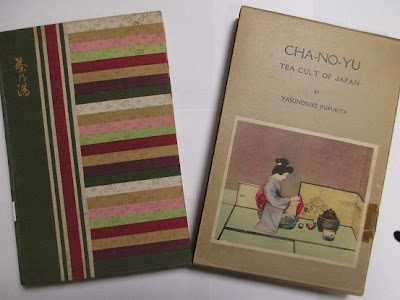
In the 1930s Dr. Howard Martin returned from Japan with a large number of Japanese books which he then donated to Monmouth College. Many of these books are exquisite examples of the Japanese bookbinder’s art, which is famous worldwide. For instance, this title is not only found inside a slipcover with pictures on the front and back, but the striped fabric cover of the book itself is a beautiful example of Japanese detailing.

The book itself presents an English language version of the art of drinking tea, a subject taken very seriously by many nations in the Far East, especially Japan and China. In Japanese culture, one is not just invited over for a microwaved mug of hot water with a teabag in it, but one can be treated to a centuries’ old ritual involving a number of special implements, towels, cups, saucers and tea pots.
This book goes into detail not only on the tea ceremony itself, but describes the proper setting for such a ceremony.

In the past, it was customary for wealthy people to have a tea house on their property, where the tea ceremony could be performed properly for the family and guests. There are numerous “schools” of the tea ceremony, with each ones rituals being slightly different. A short history of the tea ceremony is given at the beginning of the book and some of the schools are mentioned. However this book was printed for the traveler to Japan to learn something about the tea ceremony, so it just gives a general overview of the ceremony.

The Special Collections title referred to above is not the only example of tea ceremony titles held by Hewes Library. There is a book from the 1960’s on the tea ceremony found in the regular collection and one found in the oversize collection. Monmouth College is also one of the few places with copies of a magazine devoted to the culture of tea, Chanyou Quarterly, Tea and the Arts of Japan. This title, published by the Urasenke school of tea ceremonies can be found in the basement periodicals section.

The tea ceremony is not dead, but alive and well with many practitioners found in America. There are several videos on YouTube of the tea ceremony; here is a link to a short one (8 minutes) which demonstrates the simplest form of tea ceremony: http://www.youtube.com/watch?v=ebQ384WZ5Po
For those with more interest, here is a link to a long video demonstrating the Urasenke tea ceremony in full (nearly 30 minutes in length) http://www.youtube.com/watch?v=mCM6l1r1SqQ
The tea ceremony encourages relaxation and refreshment, so during exams, take a little time to have your own tea ceremony. Have a cup of tea and take a short breather before hitting the books again.

In the 1930s Dr. Howard Martin returned from Japan with a large number of Japanese books which he then donated to Monmouth College. Many of these books are exquisite examples of the Japanese bookbinder’s art, which is famous worldwide. For instance, this title is not only found inside a slipcover with pictures on the front and back, but the striped fabric cover of the book itself is a beautiful example of Japanese detailing.

The book itself presents an English language version of the art of drinking tea, a subject taken very seriously by many nations in the Far East, especially Japan and China. In Japanese culture, one is not just invited over for a microwaved mug of hot water with a teabag in it, but one can be treated to a centuries’ old ritual involving a number of special implements, towels, cups, saucers and tea pots.
This book goes into detail not only on the tea ceremony itself, but describes the proper setting for such a ceremony.

In the past, it was customary for wealthy people to have a tea house on their property, where the tea ceremony could be performed properly for the family and guests. There are numerous “schools” of the tea ceremony, with each ones rituals being slightly different. A short history of the tea ceremony is given at the beginning of the book and some of the schools are mentioned. However this book was printed for the traveler to Japan to learn something about the tea ceremony, so it just gives a general overview of the ceremony.

The Special Collections title referred to above is not the only example of tea ceremony titles held by Hewes Library. There is a book from the 1960’s on the tea ceremony found in the regular collection and one found in the oversize collection. Monmouth College is also one of the few places with copies of a magazine devoted to the culture of tea, Chanyou Quarterly, Tea and the Arts of Japan. This title, published by the Urasenke school of tea ceremonies can be found in the basement periodicals section.

The tea ceremony is not dead, but alive and well with many practitioners found in America. There are several videos on YouTube of the tea ceremony; here is a link to a short one (8 minutes) which demonstrates the simplest form of tea ceremony: http://www.youtube.com/watch?v=ebQ384WZ5Po
For those with more interest, here is a link to a long video demonstrating the Urasenke tea ceremony in full (nearly 30 minutes in length) http://www.youtube.com/watch?v=mCM6l1r1SqQ
The tea ceremony encourages relaxation and refreshment, so during exams, take a little time to have your own tea ceremony. Have a cup of tea and take a short breather before hitting the books again.
Saturday, May 4, 2013
Don't forget! Return your library materials
As the spring semester winds down, don't forget to return your Hewes Library, I-Share, and Interlibrary Loan materials once you are done with them. You can return materials to the library's circulation desk or drop boxes are available inside the library and outside, on the west terrace.
Thursday, May 2, 2013
Finals Week Hours: Open until 2am!
Hewes Library will be open until 2am during finals. Our full hours are:
Finals Week, Spring 2013 (May 2 - May 8)
Finals Week, Spring 2013 (May 2 - May 8)
- Thursday - Friday, May 2 - 3: 7:30 a.m. - 2:00 a.m.
- Saturday - Sunday, May 4 - 5: 9:00 a.m. - 2:00 a.m.
- Monday - Tuesday, May 6 - 7: 7:30 a.m. - 2:00 a.m.
- Wednesday, May 8: 7:30 a.m. - 6:00 p.m
Monday, April 29, 2013
Treasures of the Collection: Official War Records Part III (post-Civil War)
Official War Records Part III (post-Civil War)

After the Civil war the U.S. military engaged in a number of conflicts, among them; the Spanish-American War, various Caribbean military interventions in the early 20th century, World Wars I and II, the Korean War, the Vietnam War and the Iraq/Afghanistan conflicts. Most, but not all, of these conflicts were the subject of official government histories. For the Spanish American War and the Caribbean interventions, no “official” government histories were written. However after World War I the Historical Section of the Army War College wrote a 17 volume official history of the conflict and the Army’s participation in it. Published in 1948 and republished in 1988 by the Center for Military History (CMH), these 17 volumes comprise the official record of the Army Expeditionary Forces (AEF) in Europe in 1917-1918. Hewes library has the 1988 republication found at D114.8:

In the middle of World War II, the Army created the General Staff historical branch in July 1943 which is now known as CMH. This organization composed of historians, translators, editors, and cartographers began the publication of the Army’s official history of World War II. Now comprising 79 volumes, the Green Books as they are called are a detailed accounting of all aspects of the Army’s participation in that war. Go downstairs to the Ds and look for the green backed books. These will all be volumes in the Army’s official history (but some of the titles are tan, not green). There are also official Marine Corps histories of the conflict found in the same section.

Subsequently, CMH wrote a series of books on the Army’s participation in the Korean and Vietnam Wars and is currently writing a history of the Cold War. The Navy and Air Force historians have also written histories of those services’ participation in various conflicts.
All of the more recent military histories, regardless of service are found in the D section of the basement. Here is a breakdown of the areas to check for more these histories.
Air Force Histories: D 301
Army Histories: D 114.7
Marine Corps: D 214.13
Navy Histories: D 207.10 and D 221.2

After the Civil war the U.S. military engaged in a number of conflicts, among them; the Spanish-American War, various Caribbean military interventions in the early 20th century, World Wars I and II, the Korean War, the Vietnam War and the Iraq/Afghanistan conflicts. Most, but not all, of these conflicts were the subject of official government histories. For the Spanish American War and the Caribbean interventions, no “official” government histories were written. However after World War I the Historical Section of the Army War College wrote a 17 volume official history of the conflict and the Army’s participation in it. Published in 1948 and republished in 1988 by the Center for Military History (CMH), these 17 volumes comprise the official record of the Army Expeditionary Forces (AEF) in Europe in 1917-1918. Hewes library has the 1988 republication found at D114.8:

In the middle of World War II, the Army created the General Staff historical branch in July 1943 which is now known as CMH. This organization composed of historians, translators, editors, and cartographers began the publication of the Army’s official history of World War II. Now comprising 79 volumes, the Green Books as they are called are a detailed accounting of all aspects of the Army’s participation in that war. Go downstairs to the Ds and look for the green backed books. These will all be volumes in the Army’s official history (but some of the titles are tan, not green). There are also official Marine Corps histories of the conflict found in the same section.

Subsequently, CMH wrote a series of books on the Army’s participation in the Korean and Vietnam Wars and is currently writing a history of the Cold War. The Navy and Air Force historians have also written histories of those services’ participation in various conflicts.
All of the more recent military histories, regardless of service are found in the D section of the basement. Here is a breakdown of the areas to check for more these histories.
Air Force Histories: D 301
Army Histories: D 114.7
Marine Corps: D 214.13
Navy Histories: D 207.10 and D 221.2
Sunday, April 28, 2013
Digital Public Library of America
The Digital Public Library of America recently launched and strives to collect and make available the contents of libraries around the country. It's mission states:
"The Digital Public Library of America brings together the riches of America’s libraries, archives, and museums, and makes them freely available to the world. It strives to contain the full breadth of human expression, from the written word, to works of art and culture, to records of America’s heritage, to the efforts and data of science. The DPLA aims to expand this crucial realm of openly available materials, and make those riches more easily discovered and more widely usable and used, through its three main elements:Visit their website to view a few of their current digital exhibitions, including The Great Depression and New Deal, Indomitable Spirits: Prohibition, and This is Your Land: Parks and Recreation.
1. A portal that delivers students, teachers, scholars, and the public to incredible resources, wherever they may be in America. Far more than a search engine, the portal provides innovative ways to search and scan through the united collection of millions of items, including by timeline, map, format, and topic.
2. A platform that enables new and transformative uses of our digitized cultural heritage. With an application programming interface (API) and maximally open data, the DPLA can be used by software developers, researchers, and others to create novel environments for learning, tools for discovery, and engaging apps.
3. An advocate for a strong public option in the twenty-first century. For most of American history, the ability to access materials for free through public libraries has been a central part of our culture, producing generations of avid readers and a knowledgeable, engaged citizenry. The DPLA will work, along with like-minded organizations and individuals, to ensure that this critical, open intellectual landscape remains vibrant and broad in the face of increasingly restrictive digital options. The DPLA will seek to multiply openly accessible materials to strengthen the public option that libraries represent in their communities."
Saturday, April 27, 2013
Preservation Week: More Web Resources
Learn more about Preservation Week on the web from the following resources:
ALCTS Preservation Week: www.ala.org/preservationweek
Institute of Museum and Library Services, Connecting to Collections
Links to online resources, grouped by category, at http://www.imls.gov/collections/index.htm, and a
bibliography of collections care titles distributed as a bookshelf to more than 2,500 local libraries and
museums (http://www.imls.gov/news/2008/080508_list.shtm). Includes hard-to-find categories like
audio-visual and digital materials. Information includes video and news about IMLS’s national conservation initiative.
 Library of Congress: Preservation
Includes simple instructions for preserving family treasures and caring for collections with links to more comprehensive information grouped by topic and type of material.
Society of American Archivists: Preservation
Selected Links to Preservation Web Sites, Links to a wide variety of Web sites with preservation information useful to archivists and archives, among others. Memories and treasures should last a lifetime and be passed on to future generations. President Obama once wrote, “Part of America's genius has always been its ability to absorb newcomers, to forge a national identity out of the disparate lot that arrived on our shores.” The memories and treasures of individuals, families, and communities are essential to our record of this process—they contribute to our understanding of history and its participants just as collections in libraries, museums, and archives do.
-Excerpted from What is Preservation Week?
ALCTS Preservation Week: www.ala.org/preservationweek
Site provides information and ideas to help you celebrate Preservation Week. It includes a Speakers
Bureau, tip sheets, links to basic and extensive preservation information, and information about programs to be offered during Preservation Week. It is complemented by an ALA Preservation@Your Library web page for the general public.
American Institute for the Conservation of Historic and Artistic Works: Caring for
Guidance for care of common categories of collections, printable as handsome two-sided 8.5 x 11” broadsides. Heritage Preservation: Heritage Health Index and The Caring Books and Downloadable Documents. These provide valuable preservation information, with extremely useful information about responding to sudden emergencies in collections.
Institute of Museum and Library Services, Connecting to Collections
Links to online resources, grouped by category, at http://www.imls.gov/collections/index.htm, and a
bibliography of collections care titles distributed as a bookshelf to more than 2,500 local libraries and
museums (http://www.imls.gov/news/2008/080508_list.shtm). Includes hard-to-find categories like
audio-visual and digital materials. Information includes video and news about IMLS’s national conservation initiative.

Includes simple instructions for preserving family treasures and caring for collections with links to more comprehensive information grouped by topic and type of material.
Society of American Archivists: Preservation
Selected Links to Preservation Web Sites, Links to a wide variety of Web sites with preservation information useful to archivists and archives, among others. Memories and treasures should last a lifetime and be passed on to future generations. President Obama once wrote, “Part of America's genius has always been its ability to absorb newcomers, to forge a national identity out of the disparate lot that arrived on our shores.” The memories and treasures of individuals, families, and communities are essential to our record of this process—they contribute to our understanding of history and its participants just as collections in libraries, museums, and archives do.
-Excerpted from What is Preservation Week?
Friday, April 26, 2013
Preservation Week: Charles Wilt on Preservation
Charles Wilt, ALCTS Executive Director, shares his thoughts on Preservation Week:
Subscribe to:
Posts (Atom)