Showing posts with label archives. Show all posts

Tuesday, April 27, 2021

Preservation Week

Welcome to Preservation Week!

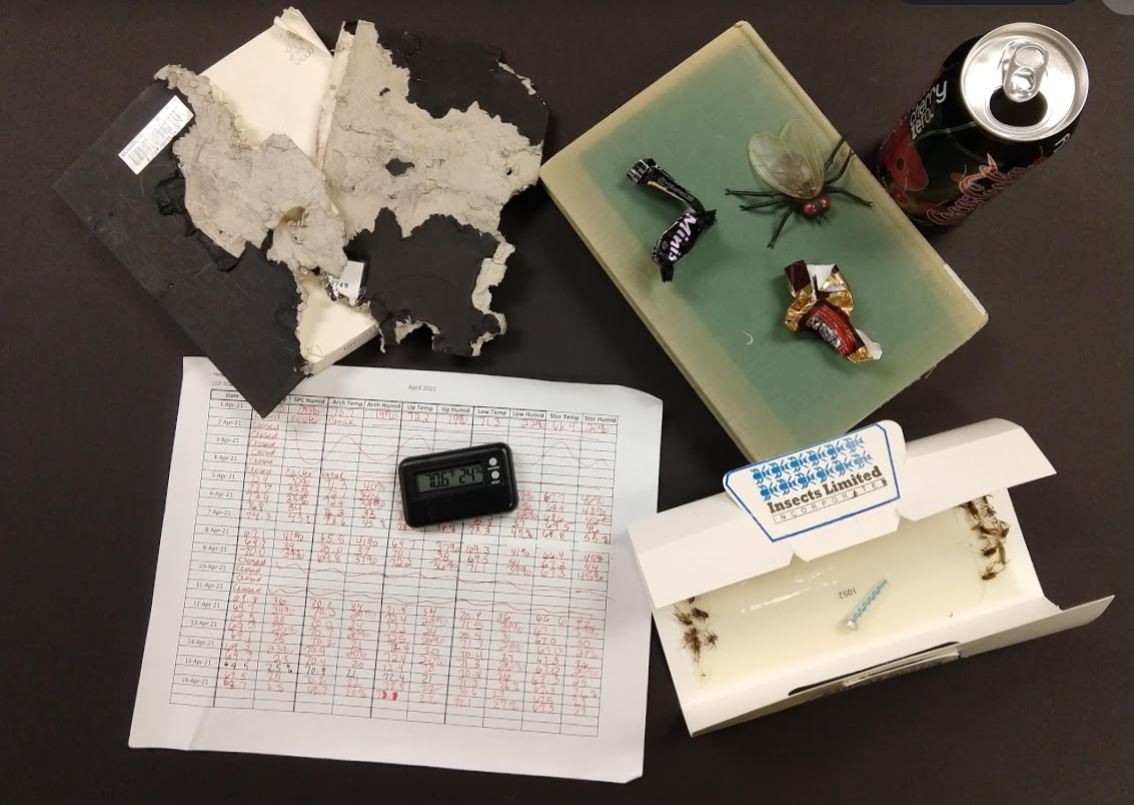
What is Preservation? It is about the “Big Picture”. Libraries, museums, and archives of all kinds keep an eye on the environment that materials live in. Hewes Library monitors temperature and humidity to keep our books comfortable and we try to minimize contact with direct sunlight, so they don’t fade away.

We discourage eating and drinking around collections just in case there is a spill! We also keep an eye out for critters, because they like to eat and drink...and they like to eat and drink our books and the materials they are made of!

We also ask that users take good care of the items they are borrowing…puppies like books, too, just not for reading!
😉

Pictured: a chewed up book, examples of food and drink and the pests that they attract, and the Hewes Library temperature and humidity logs.

Sunday, March 7, 2021

HIST 290 Student Display

Bailey Shimmin, a student in HIST 290 Archives Practicum with Technical Services librarian, Lynn Daw, has produced a display featuring the history of Grier Hall. 

As part of the theory and practice of archival methods, students in the course will be creating displays throughout Hewes Library this semester. Bailey utilized materials from the college archives (photographs, newspapers and documents) for the display available by the west entrance to the library.  

Students in the course were featured earlier this semester by Monmouth College while they inspected materials from Monmouth's First United Methodist Church time capsule.


Wednesday, January 8, 2020

New Exhibits: Qur'an and Bookmaking

Hewes Library has several new exhibits to view on the main floor.

West entrance: 1788 Handwritten Qur'an


This exhibition case will rotate often to showcase materials from the Monmouth College Special Collections & Archives. Currently on display is a handwritten copy of the Qur'an donated to Monmouth College by Reverend Gulian Lansing, who also donated the college's copy of the Conopus Stone.


East entrance: "Books as Art"


Currently on display are handmade books created in Professor Stephanie Baugh's ARTD 231. Examples of accordian, coptic, and stab binding are displayed throughout the two cases. This exhibit will be available throughout the month of January.

Thursday, March 1, 2018

Current Displays @ Hewes

Need a distraction from studying or a reason to walk to the library?

A variety of informational displays can be found in Hewes Library this month.

"LGBTQ: History, Life Stories and Performance"
A selection of library materials on the history of the lesbian, gay, bisexual, transgendered and queer movements in the United States, with a special focus on autobiographies and the performing arts. This display features QR codes for many of the materials on display, which will lead the user to the actual item either physically in Hewes Library, available to borrow from the I-Share catalog, or to utilize electronically.


"Books You Always Meant to Read" 
A selection of books we always meant to read, but haven't...yet! Check them out, and add YOUR to-do title to the growing suggestion list.


"My MC Memories"
A rotating exhibition of scrapbooks from the Monmouth College Archives, a fantastic peek into these cultural artifacts.


And finally, on the main floor, we are showcasing pieces from our James Christie Shields Collection (two beautiful porcelain pieces from Korea) and our Takashi Komatsu Collection (two gorgeous Hiroshige woodcuts of winter scenes in Japan).


Friday, January 19, 2018

Display of Local Journalism

Come and appreciate a slice of local journalism on exhibit on the main level of Hewes Library courtesy of the Warren County Historical Museum. 

From the exhibit:
"Warren County has been home to a number of journalistic mediums over the years, many of which continue to this day. The Monmouth Review Atlas, the Roseville Independent, and the Monmouth College Courier are the primary newspaper sources in the area, but a number of other outlets can be found as well. Radio stations, having become popularized during the Great Depressions, are still a main source of information for much of the local population today."


We thank Warren County Historical Museum Executive Director Kellen Hinrichsen for preparing this exhibit! "Local Journalism: Keeping the Community Informed" will be on display on the east side of the main level through mid-February.


Thursday, November 3, 2016

New Resource: Accessible Archives is a treasure trove of American history


The newest resource on the Hewes Library website, Accessible Archives, provides digitized resources from 18th-19th century United States publications, colonial times through the end of the 19th century.

"Developed by dedicated instructors and students of American history, our databases contain the rich, comprehensive material found in leading historic periodicals and books.
Eyewitness accounts of historical events, vivid descriptions of daily life, editorial observations, commerce as seen through advertisements, and genealogical records are available in a user-friendly online environment."

In addition to American history, the collections provide support in women’s studies, American literature, theater and early American music. 

See the collection and coverage list and satisfy your curiosity by doing a few searches yourself!


Article written by members of the Toledo Woman Suffrage Association, 1876.

Williams. S. L.,  Angier, J. P., Fray, E. S., & Barker, M. J. (1876, April). Twenty millions of American citizens are denied all representation. The National Citizen and Ballot Box , p. 1.


Wednesday, September 21, 2016

Participate in Monmouth Culture Stroll 9/23

The Monmouth Culture Club hosts its first ever Monmouth Culture Stroll on Friday, September 23 from 2-7pm. Complete a "passport" and you're entered to win the prize package shown!


prize
Culture Stroll prize package

These six locations are participating:
Warren County History Museum: 2-7pm; behind-the-scenes tours and the showing of a documentary on the museum.

Buchanan Center for the Arts: 2-6:30pm; sneak peak of an upcoming exhibit that will be in the middle of installation, along with refreshments.

Warren County Public Library: 2-5pm; scavenger hunt in the library, along with refreshments.

Hewes Library at Monmouth College: 2-5pm; tours of the archives, library, Shields Collection, and archaeology lab.

The Stewart House: 2-7pm; tours of the house, a Victorian style tea, and croquet on the front lawn.

Holt House: 2-7pm; tours of the house along with informative discussion

Friday, December 4, 2015

From the Archives: Aerial Photographs of Monmouth College


Stop by the Archives case on the Main Floor to view some of the aerial photographs of the Monmouth College campus over the years.  How many buildings can you identify?

Friday, May 9, 2014

From the Archives: The Naval Flight School


The Naval Flight School Collection was added to the Monmouth College Digital Collections and contains photographs and materials related to the US Naval Flight Preparatory School and the US Navy Academic Refresher Unit.


Student Karrah Kuykendall worked under the direction of Lynn Daw, Technical Services Librarian and Archivist, to complete her HIST 390 course preserving and digitizing the Naval Flight School Collection.


During WWII, Monmouth College served as one of seventeen institutions selected by the U.S. Navy as a Naval Flight Preparatory School. In 1944, the NFPS transitioned to a Naval Academic Refresher Unit. This collection reflects on the important role of MC in the war effort and is a unique glimpse into life on the Monmouth College campus during the war.


A large portion of the collection is the Wing Tips Newsletter, which was written by the cadets and features information on WWII, maintaining grades, and social events on Monmouth College's campus.

Wednesday, March 26, 2014

MC Archives ...and the rest is history!


Each week, be sure to stop by the West Lobby of the Hewes Library to view a selection of materials from the Monmouth College Archives.  In addition to photographs over the years, "...and the rest is history" will feature campus events, student life, and more.


Friday, December 6, 2013

From the Archives: Literary Societies with Student Ryan Cameron

Senior English major, Ryan Cameron, has spent the semester working on the Literary Societies archival collection in the HIST290 Archives Practicum.  Ryan describes his work in the following post.  After reading about his experiences, please stop by the library east entrance to view his exhibit!


Ryan Cameron: “Since freshman year, I’ve been trying to get as much undergraduate experience in library and archival science as possible here at Monmouth College.  So when Professor Daw came to me with the opportunity to turn what I was doing in my HIST-290 archives class into a display here in the library, I jumped at it!


Getting to work through the Literary Society’s boxes to begin with was great fun—as an English Major, I assumed that these societies would be something like book clubs, but as it turns out, the four Monmouth College literary societies—Philadelphian, Eccritean, Amateurs des Belles Lettres, and Aletheorian—were more oratorical in nature, giving speeches written both by members of the groups and by great speakers, authors, and thinkers of the times.  In fact, Monmouth College’s four literary societies were among the most famous, and from the beginning of the College’s existence until the early 1900’s, became what the college was most known for.

The experience of putting this display together has been great—I had to work through the planning stages, often by taking pictures of the display cabinet and creating mock-ups of the shelving to see where and how things would fit together thematically.  Ultimately, once I was in front of the case placing things on shelves, it was all a lot easier than I thought it was going to be, but I think the planning stages were some of the most beneficial to me as a student of the archives.

Getting to see my work displayed every day makes me feel like I’ll have a real heads-up on my graduate school classes.  But most of all, it feels great to be able to bring to light something that once was such a prominent part of Monmouth College’s history that has somehow fallen so by the wayside.”

Thursday, October 31, 2013

National Archives Month: What’s Up in the Archives?

Any collection or item that is “Up in the Archives” always begins by spending sometime “down in the workroom”.  The real archival work takes place in the technical processing room on the first floor of the library, away from the Archive collections room.  Here in the workroom there are always various projects underway that comprise the daily tasks of Archival work.


Archivists are all about arranging files in logical order so they are easier to use.  We research the creators of collections and describe the contents using finding aids and catalog records so users can discover and access them.  We also spend a considerable amount of time preserving and protecting our collections from the elements, using acid-free folders, Mylar sleeves, and sturdy boxes and paying attention to light levels, temperature and humidity.  We even perform a few repairs to those items that have been ripped or torn, or scan and digitize a document to preserve it and provide access via the web. ...a little TLC goes a long way!


Throughout the processing and hands-on work, we can become extremely attached to our documents and their creators…WE LOVE OUR STUFF!  And more importantly, we love to share it.  Does Archival Science sound like something you’d be interested in?  Stop by the library to check out the collections and find out about courses in library, archival, or museum science!

Wednesday, October 16, 2013

National Archives Month: Homecoming Displays with Brittany Zenge '14

History Major, Brittany Zenge, ’14, has been spending the semester working on an independent study in Museum Studies (HIST 390).  Working with Archivist, Lynn Daw, she is examining the history of museum collecting, preservation, exhibition, and interpretation.  Her first love of these museum tasks is exhibits and displays, so what better mid-term assignment than creating just that for last weekend’s 2013 Homecoming events! 

Brittany interprets her experience in the following post:

Library Cases
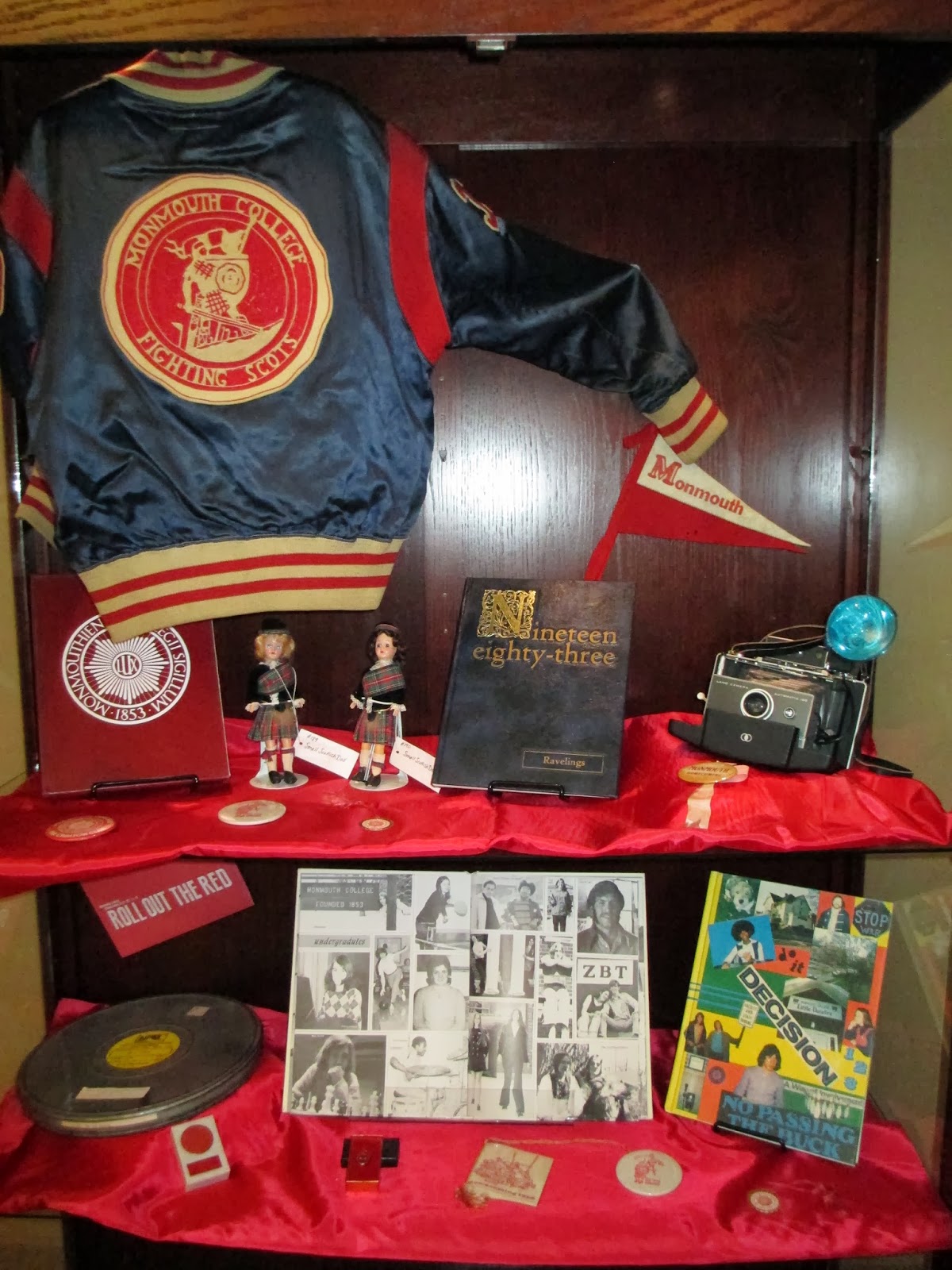
"When Lynn asked me to design the library cases for Homecoming, I was ecstatic. I immediately wanted to get my hands on all of the artifacts in the archives. To decide on which artifacts to put in the case, I firstly had to decide what theme I wanted to go with. Seeing as it was Homecoming, there was a ready made title to bring to life, “Roll Out The Red.” From there I decided to make the cases resemble the red carpet like you see in Hollywood. This helped with picking out specific artifacts, like the roll of film and older camera.

My main goal was to keep to the Homecoming feel, therefore I kept pieces like the athletic jacket, football jersey, pipe band uniform and the yearbooks to signify those alums coming back to celebrate their time at Monmouth College.  Lastly, I placed Homecoming pins and Monmouth College banners inside each case to help represent school pride during this exciting weekend.

At MC, students can investigate the inter-related professions of Library Science, Archive Management, and Museum Studies, through a variety of courses and independent studies, no matter what major field of study they are pursuing.   Stop by the library for more information!"

Tuesday, October 8, 2013

National Archives Month: What's Up in the Archives

October is American Archives Month!  This is a time to focus on the importance of the documents and items that record our daily lives, records created by individuals, organizations, and governments.  “What records?” you might ask…

Think for a moment about your daily activities and the records you create.  These notes of daily life: correspondence, emails, tweets, diaries, legal documents, receipts, photographs, video and sound recordings, can all be considered potential Archival material when they contain enduring value and enhance a collective public memory.

How about a college student’s scrapbook from 1917 or the personal collections of a jazz aficionado?  Perhaps a page from the Apollo 11 flight plan? … A recording from President John F. Kennedy that reveals as much about being a father as it does about being president… or a photograph of a little girl and her bonnet taken during the Civil War.

Each of these historical records contains a lasting, intrinsic value that speaks volumes about a place and time and the people and culture that created them.  How do our records created today reflect what we are about? How are we making memories?


Friday, June 7, 2013

From the Archives: Digitizing MC Student Life


As part of Hewes Library's ongoing digitization efforts, librarians and students worked together over the 2012-2013 school year to scan and make portions of the MC Archives Student Life Collection available online.  History Department Instructor and Technical Services Librarian, Lynn Daw supervised student Olivia Haines on a yearlong project that assessed, scaned, and cataloged scrapbooks from the Student Life Collection. 


The first items in the collection are scrapbooks from MC students Grace Acheson Rogers, Lois Glass, and Luella Beveridge.  The scrapbooks are part of the collection that serves to reflect campus life through the eyes of Monmouth College students over the past 160 years.
 
 
Photographs, scrapbooks, documents, and memorabilia record the activities of individual students as well as various clubs, groups, and campus organizations. These objects continue to display the traditions and culture of a small, private, midwestern liberal arts campus and its vibrant youth.
 
Watch the Monmouth College Archives or the Hewes Library blog for future updates to the collection.


Wednesday, February 27, 2013

From the MC Archives: The Dolphin Club

From the Monmouth College Archives:


Starting in the late 1940’s, early 1950’s, the Dolphin Club was a recreational participation group involved with women’s swimming. They specialized in synchronized swimming along with water “stunts”. This was a team the women tried out for in order to measure the variety of skill. The Dolphins put on performances, sometimes collaborating with the Orchesis, a modern dance organization at Monmouth College that had been around since 1950.  Two of their performances were “Westward Ho!” in 1970, and “Splash In Color” in 1967. These photographs are from the production “Westward Ho!”


Thursday, October 11, 2012

Treasures of the Collection: Monmouthania for Homecoming 2012

Treasures of the Collection: Monmouthania

October is a time of nostalgia.  The falling leaves and cooler weather remind one that the end of another year is coming.  Colleges use this time of year to hold homecomings and invite alumni to return to their alma maters giving them an opportunity to catch up with old friends, find out what’s new and to participate in a variety of events, including a football game.  To help get in the mood for the return of the alumni, this column will take a look at the large collection of Monmouthania held by the library. 
 
 
What is Monmouthania?  It is the name used to describe all sorts of memorabilia directly related to the college.  Included are such items as the book, “How to study at Monmouth College” from 1957, a Wee Scots guide 1955-56, explaining for new students, “…the traditions and rules of Monmouth College…”, dance cards and favors used by young women at formals given by various campus groups such as the TKE Orchid formal of 1958, the student council Spring formal 1936, and the unaffiliated women of Monmouth College’s “Evening in Jade”.  All of this material can be seen in the display cases found in the Special Collections room on the second floor of the library. 
 
 
But that is not the only material available there. Another case contains books written by current and former Monmouth College faculty.  Included in these is “The Theology of New England” by D.H Wallace, the first president of Monmouth College (1857-1876) and “Charlotte’s Web” (Tela Charlottae) translated into Latin by Bernice Fox, a professor of Classics at Monmouth College from 1947-81.  Books by current faculty members William Urban and Thomas Sienkewicz are also included in the display.  Still other cases contain sports memorabilia and one shelf memorializes former music faculty member Gracie Peterson with photos and proclamations.


On the ground floor, behind the Reference disk you can find a collection of old yearbooks, alumni directories, catalogs and books about Monmouth College, Monmouth and Warren County. 

Can’t make to homecoming this year, but still want to relive old memories?  Then take a look at the MC on-line archives, consisting of two sites where you can find searchable versions of the student newspapers, catalogs and yearbooks.

Thursday, September 15, 2011

Gen. Abner Clark Harding's Artifacts Donated to Monmouth College

The personal effects belonging to a renowned Civil War general and railroad builder will be presented to Monmouth College by his family descendants on Saturday at Hewes Library.

During the 10 a.m. ceremony in Hewes Library, an officer’s sword, a family Bible, an engraved walking stick and a photographic portrait by Matthew Brady will be among the items presented to college president Mauri Ditzler by family members of Gen. Abner Clark Harding.  The public is welcome.

A brief Monmouth College history of Gen. Harding:

Harding (1807-1874) was one of the principal founders of Monmouth College in 1856, having donated the land for its first building and the endowment for its first professorship. Born in Connecticut, he settled in Monmouth in 1835, where he plied his trade as an attorney until failing eyesight made him abandon that career. In 1851 he formed a company to build a railroad from Peoria to the Mississippi River, eventually selling the route to the Chicago, Burlington and Quincy line for a tidy profit.


At the age of 55, despite poor eyesight and health, Harding enlisted as a private in the Union Army, but was immediately elevated to colonel and took command of the 83rd Illinois Volunteer Infantry, a regiment populated heavily with Monmouth College students. Assigned to guard the Cumberland and Tennessee rivers, he held off a Confederate force that outnumbered his troops 10 to 1 at the Battle of Dover in 1863, a feat that resulted in a field promotion to brigadier general.

Following the war, Harding successfully ran for Congress on the Republican ticket. One of his most significant accomplishments during two terms in office was personally securing the charter to build a railroad bridge across the Mississippi at Burlington. He also served as first president of the National Bank of Monmouth. He is buried in the Harding family plot in Monmouth Cemetery.


Wednesday, January 19, 2011

May 1882: The dismissal of Miss Lizzie Gowdy, art instructor

Monmouth College History: Archival Discoveries by J. Richard Sayre, Library Director

May 1882: The dismissal of Miss Lizzie Gowdy, Art Instructor

Last fall while reading through some of the Faculty Minutes from the 1880s for a trustee, I ran across a series of faculty meetings from May 1882 in which the faculty passed a resolution calling for the immediate resignation of Miss Lizzie Gowdy, Art Instructor. Miss Gowdy was apparently observed by the faculty as sporting a Kappa Kappa Gamma pin on her blouse or jacket which was in violation of the college’s “well-defined” policy concerning “secret fraternities” on campus. The first two women’s “fraternities” in the nation were formed on the Monmouth College campus in 1869 (Pi Beta Phi) & 1870 (Kappa Kappa Gamma). Yet by 1874, both men and women’s fraternities were banned from the campus due to concerns from the Presbyterian Church. Nevertheless, through the early 1880s, there were still “secret” fraternity activities and the ban on fraternity pins worn by students towards the end of the 1870s had not been strictly enforced - according to Dr. William Urban’s History of Monmouth College through Its Fifth Quarter-Century (c1979). However, young Lizzie Gowdy, former student, now art instructor, proudly wore her Kappa pin on a regular basis in defiance of college policies, and refused to resign when pressured by the MC faculty. Because of Gowdy’s refusal to resign voluntarily, the matter was referred by the faculty to the board of trustees, where, according to Urban’s History of Monmouth College (p.82), Miss Gowdy was eventually dismissed.

Shortly after reading these entries in the faculty minutes, I shared this bit of interesting information with Hollie Casteel, Hewes Library Acquisitions Manager. Intrigued about what might have become of Miss Gowdy, Ms. Casteel found a reference to an Elizabeth Gowdy Baker via Google, born in 1860, Xenia, Ohio, graduated Monmouth College, with further schooling at Cooper Union and other art schools. This discovery started both of us on a search for more information on the Monmouth College alumna and instructor who left Monmouth under difficult circumstances and went on to make a name for herself in the art world.

Elizabeth Gowdy Baker became a rather well known watercolorist in late 19th, early 20th century America, the first portrait artist to successfully use watercolor as her medium. She was initially well known for her work with children’s portraits, but soon became a sought-after portrait artist of the wealthy and prominent citizens of New York City, Boston, Philadelphia and Cincinnati. Photographs of a number of her portraits appear in American Art News from 1897-1920. And there’s a library connection - she painted a rather impressive portrait of Melvil Dewey, father of the Dewey Decimal Classification and founder of the first school for training librarians at Columbia University. The portrait is found in the Lake Placid Club, New York, and was reproduced in a 1968 article in The Journal of Library History. She also served as president of the Society of Aquarellists and the Daughters of Ohio. There are many articles in the JSTOR database mentioning Elizabeth Gowdy Baker and several websites that include some of her paintings up for auction.

So did the Monmouth College faculty’s call for Miss Gowdy’s resignation do this young art instructor a favor in the end? She could have been no more than 22 years old at the time, probably hired to teach following her graduation from Monmouth College. It would appear that she landed on her feet, studied in prominent art schools, married, and eventually became a very successful portrait artist for the rich and famous of society in some of America’s largest cities. Yet I still wonder if Elizabeth Gowdy Baker was able to forgive the Monmouth College faculty and trustees for their actions which may have helped to launch her successful career as an artist.